
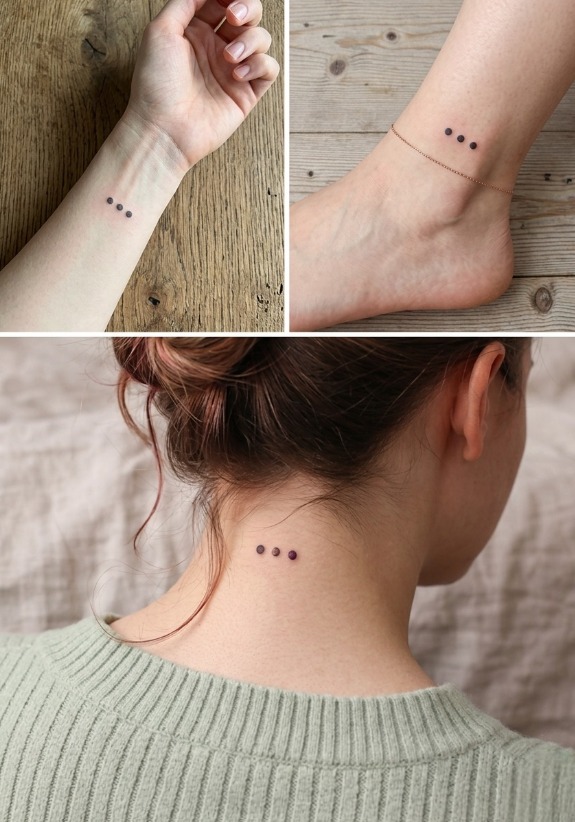
The three-dot tattoo is a small design, but its meaning can be surprisingly layered. Often placed on the hand—between the thumb and forefinger or along the knuckles—it has been associated with the idea of the “Three Wise Monkeys,” symbolizing the principle of “see no evil, hear no evil, speak no evil.” In this context, it reflects restraint, awareness, and a conscious effort to avoid negativity.
In other settings, particularly within certain subcultures, the tattoo can take on a different significance. It may represent loyalty, silence, and trust among a close-knit group, where discretion is valued. For some individuals, additional dots are added over time, turning the simple design into a personal marker of lived experiences or difficult periods.
Regional interpretations also shape its meaning. In parts of Latin America, the three dots are often linked to the phrase “Mi Vida Loca,” or “my crazy life.” Here, the tattoo becomes a reflection of personal history—an acknowledgment of challenges, choices, and the path someone has taken. Despite the differences in interpretation, a common thread runs through all of them: the tattoo serves as a quiet expression of identity.
At the same time, visible tattoos like this can be misunderstood, especially in unfamiliar contexts. Because the symbol carries multiple meanings, it may lead to assumptions that don’t reflect the wearer’s intent. This makes it a reminder that symbols are rarely universal—their significance depends on perspective, culture, and the story behind them.