
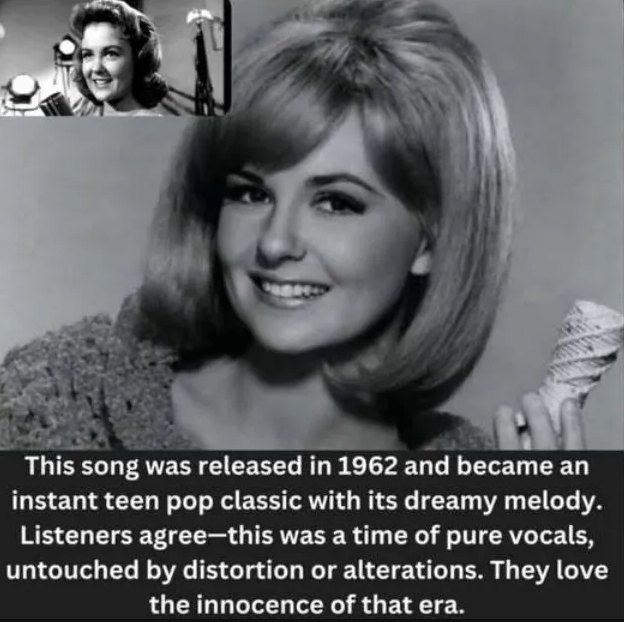
In the early 1960s, few songs captured youthful longing as gently as “Johnny Angel.” Sung by Shelley Fabares, already familiar to audiences from The Donna Reed Show, the track became more than a hit—it became a feeling. With its soft delivery and dreamy tone, it spoke directly to teenagers experiencing first love, uncertainty, and quiet hope. It wasn’t just music; it was a shared emotional moment that lingered far beyond the radio.
What made the song resonate so deeply was its simplicity. Fabares didn’t overpower it—she let it breathe. Her voice carried a kind of innocence that matched the era, allowing listeners to project their own stories into the lyrics. That connection helped the song rise quickly in popularity, embedding itself into the cultural memory of a generation that would later look back on it with nostalgia.
But success like that can be a double-edged sword. Rather than trying to build an entire music career around one defining hit, Fabares made a different choice. After a follow-up release, she stepped away from the pressure of pop stardom and returned her focus to acting. Her career continued steadily, including appearances in films alongside Elvis Presley, where she found a more sustainable creative path.
In the end, “Johnny Angel” endured without needing constant reinvention. It remains a snapshot of a specific time and emotion—untouched, sincere, and quietly powerful. Fabares’ decision to move forward rather than remain tied to a single success reflects something deeper: the understanding that one moment, no matter how iconic, doesn’t have to define an entire life.