
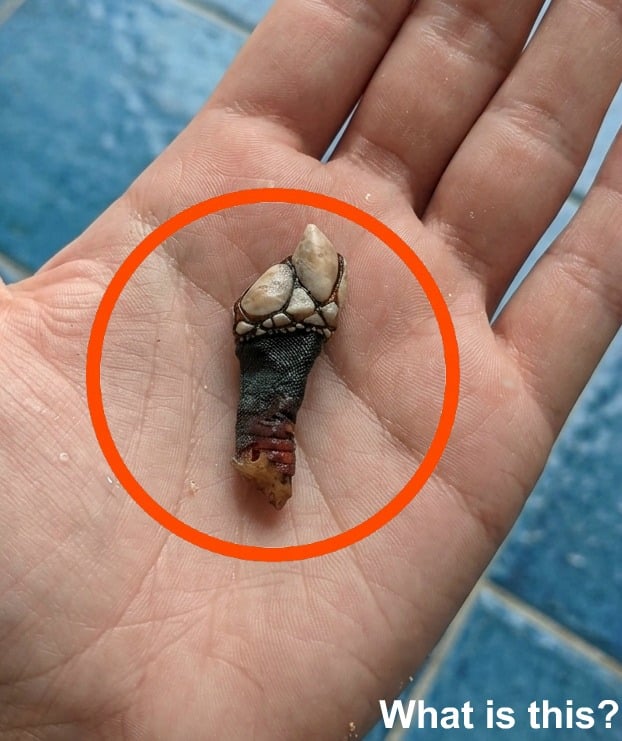
It’s easy to mistake unusual beach finds for something else—especially when they look hard, curved, or almost bone-like. But what you picked up is most likely a goose barnacle, a marine crustacean that often surprises people with its odd, almost prehistoric appearance. Despite how it looks, it’s not a tooth or bone, but a shell-covered creature that lives attached to rocks and drift surfaces along the coast.
Goose barnacles thrive in rough coastal zones where waves constantly crash against rocks. They anchor themselves tightly using a tough, flexible stalk and survive in conditions that would wash most organisms away. Over time, they can break loose and wash up on shore, which is probably how your dog discovered it. Their texture and shape—especially when dried—can make them look like something entirely different at first glance.
Interestingly, in countries like Spain and Portugal, these barnacles—known as “percebes”—are considered a delicacy. Harvesting them is risky work, often done on slippery cliffs where timing between waves is crucial. What seems like a random beach find actually connects to a much larger story of coastal life, tradition, and survival.
If you bring something like this home, it’s generally safe to handle, though it’s a good idea to rinse it and avoid keeping anything with a strong odor. Finds like this are a reminder that even a simple walk along the shoreline can uncover something unexpected—proof that the natural world is often far more fascinating than it first appears.