
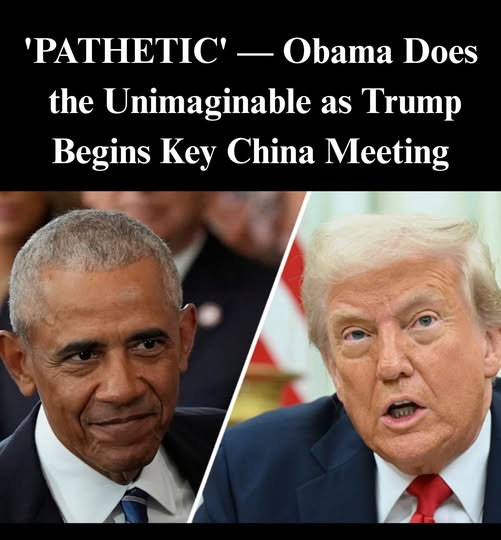
A growing political debate has emerged after Barack Obama and Donald Trump delivered sharply contrasting messages about America’s role on the global stage. The renewed clash of philosophies unfolded as Obama defended his diplomatic legacy during a public appearance in Chicago while Trump pursued high-profile economic negotiations in China alongside several of America’s most influential technology leaders.
During his remarks, Obama pointed to the Iran nuclear agreement as an example of diplomacy achieving results without military escalation. Supporters viewed his comments as a reminder of an approach centered on international cooperation, negotiations, and long-term stability. Critics, however, interpreted the timing as a direct criticism of the current administration’s more aggressive foreign policy posture, especially as global tensions and trade disputes continue shaping international headlines.
At nearly the same time, Trump appeared in Beijing accompanied by major figures from the American technology and business sectors, including Elon Musk, Tim Cook, and Jensen Huang. The visit was widely viewed as a strategic effort to showcase American economic influence and technological leadership while pressuring Chinese officials to expand market access and strengthen business cooperation. Analysts described the move as an example of Trump’s preference for leveraging economic power and corporate influence as tools of diplomacy.
The contrast between the two approaches has reignited broader questions about how the United States should navigate global leadership in an increasingly competitive world. Some Americans favor diplomacy, multilateral agreements, and cautious engagement, while others support a more confrontational strategy built around economic leverage, negotiation pressure, and direct competition with geopolitical rivals. As debates surrounding trade, security, and foreign policy continue intensifying, the public divide over America’s international direction shows little sign of fading anytime soon.