
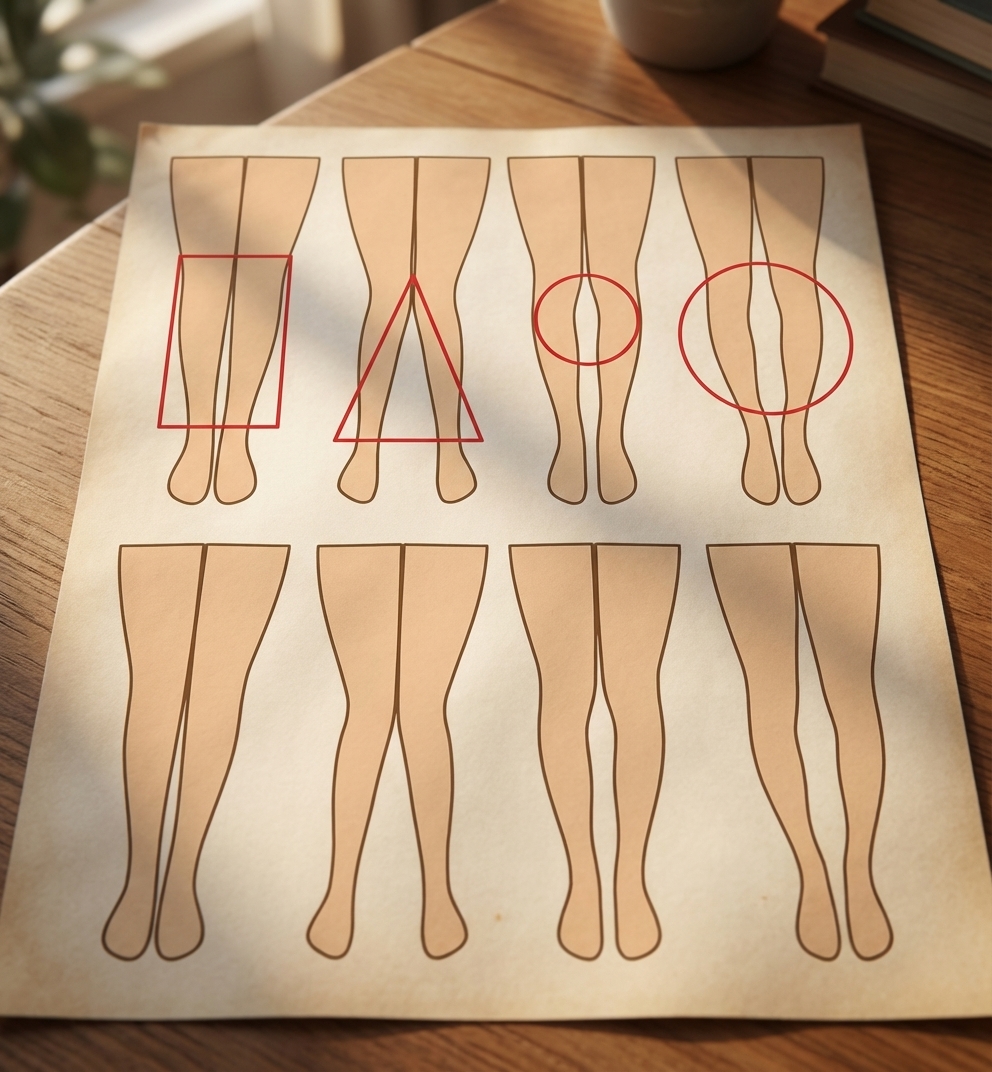
It’s tempting to think of legs as purely functional—tools for walking, running, or climbing stairs. Yet in fashion circles, fitness communities, and everyday style conversations, leg shape often becomes part of how people interpret posture, movement, and overall presentation. From runway trends to gym culture, silhouettes subtly influence clothing choices and the way individuals carry themselves. Rather than viewing this through a critical lens, it’s more refreshing—and far more accurate—to see it as a lighthearted exploration of how natural structure contributes to personal style.
Most commonly discussed leg shapes are simply variations of normal human anatomy. Genetics, bone alignment, and muscle distribution determine whether someone’s legs touch at the thighs, knees, or ankles. Straight, evenly aligned legs are often described as “balanced,” while slight inward or outward angles reflect natural joint positioning. Features like the widely discussed “thigh gap” are largely influenced by pelvic structure, not fitness level—something many health professionals frequently emphasize. Mild bowing or inward angling can also affect gait and weight distribution, shaping how a person stands or moves, without signaling anything about strength or health on their own.
Because movement patterns vary, popular culture sometimes attaches playful personality traits to different silhouettes. Straight legs may be associated with strong posture, inward angles with softer movement, and natural curvature with athletic stride. These interpretations are creative, not clinical. In fashion, leg structure can influence preferences—some may gravitate toward tailored trousers, others toward wide-leg styles, skirts, or athletic wear that complement how they move. In fitness settings, certain activities—like yoga, cycling, dance, or running—can enhance muscle tone in different ways, subtly shaping appearance over time without altering underlying bone structure.
Ultimately, leg shape is neither a measure of beauty nor a reflection of worth. It’s one of countless natural variations in the human form. Exercise can build strength and definition, but core alignment and bone structure remain largely genetic. What truly matters is comfort, stability, and confidence in movement. When we shift the conversation from comparison to appreciation, we recognize that every silhouette tells the same story: bodies are designed to support us, carry us forward, and adapt in their own distinct way.