
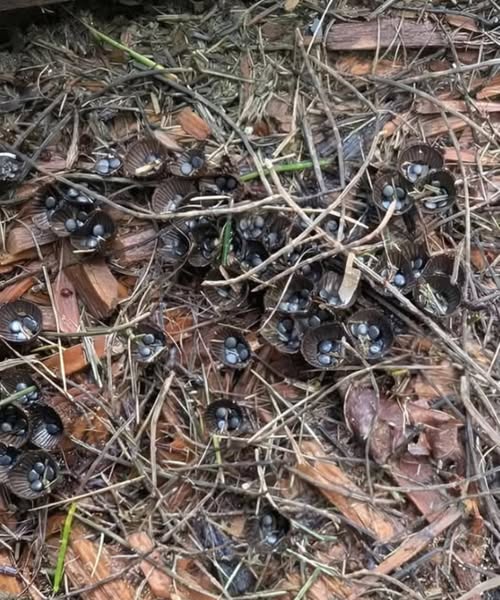
During a visit to a friend’s home, we spotted something unusual tucked between two flowerbeds — tiny, perfectly round shapes arranged like miniature nests. At first glance, we thought they might be seeds or insect eggs, but nothing quite matched their appearance. Their neat formation and delicate structure made us pause, wondering what kind of natural mystery we had just stumbled upon in the garden.
Curious and still unsure, we shared the photos with my friend’s grandfather, a devoted gardener with decades of hands-on knowledge. The moment he saw the images, he smiled knowingly. “Those are birds’ nest mushrooms,” he said. He explained that these fascinating fungi, from the Nidulariaceae family, are named for their resemblance to tiny nests filled with eggs. In reality, the “eggs” are small spore-filled capsules designed to help the mushrooms reproduce.
These mushrooms use a surprisingly clever method to spread their spores. When raindrops fall into the little “nests,” the impact sends the spore capsules flying outward, allowing them to settle in nearby soil where new mushrooms can grow. Learning how such a small organism uses rainfall to continue its life cycle reminded us just how much quiet complexity exists beneath the surface of an ordinary garden.
Since that discovery, our walks outside feel a bit more magical. Even the most familiar patches of soil can hide extraordinary wonders for anyone willing to look closely. Those tiny birds’ nest mushrooms were a humble reminder that nature is full of surprises — small moments of beauty and curiosity waiting to be noticed.