
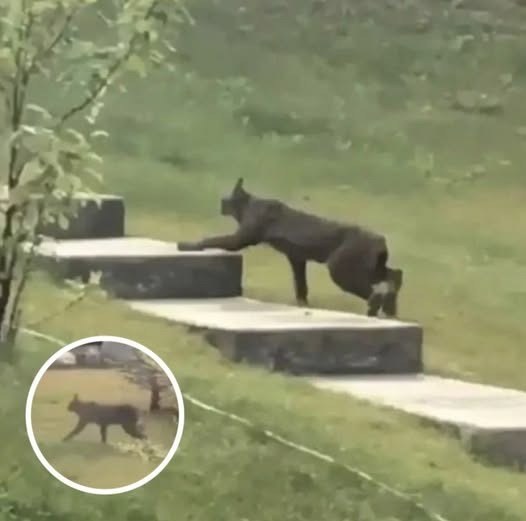
Canadian researchers have documented a remarkable wildlife first after recording a melanistic Canada lynx on a mobile phone—an unprecedented event for the species. The animal’s unusually dark coat immediately set it apart, and scientists confirmed that no previous official record of a melanistic Canada lynx had existed. The brief footage has since become an important reference point for wildlife research and conservation.
Under normal conditions, Canada lynx are known for their light gray or reddish-brown fur, coloring that provides natural camouflage in snowy boreal forests. The discovery of a dark-coated individual surprised researchers, prompting new questions about genetic diversity within the species. While visually striking, scientists noted that darker fur could be a disadvantage in snow-covered habitats, where blending into the environment is often critical for hunting and avoiding detection.
The sighting has also revived broader scientific discussion about how environmental factors may influence physical traits in wildlife. Some studies suggest that climate shifts and changing habitats can affect the frequency of darker pigmentation in certain species, though experts stress that isolated observations are not enough to establish a direct link. Still, the discovery offers a valuable opportunity to explore how genetics and environment may intersect over time.
Beyond its scientific implications, the footage has captured public imagination as a reminder of how much remains unknown—even among well-studied animals. Researchers hope the find will encourage continued monitoring, data collection, and conservation efforts. The melanistic Canada lynx stands as a rare and compelling example of biodiversity, reinforcing the importance of protecting ecosystems so extraordinary variations like this can continue to exist and be understood.