
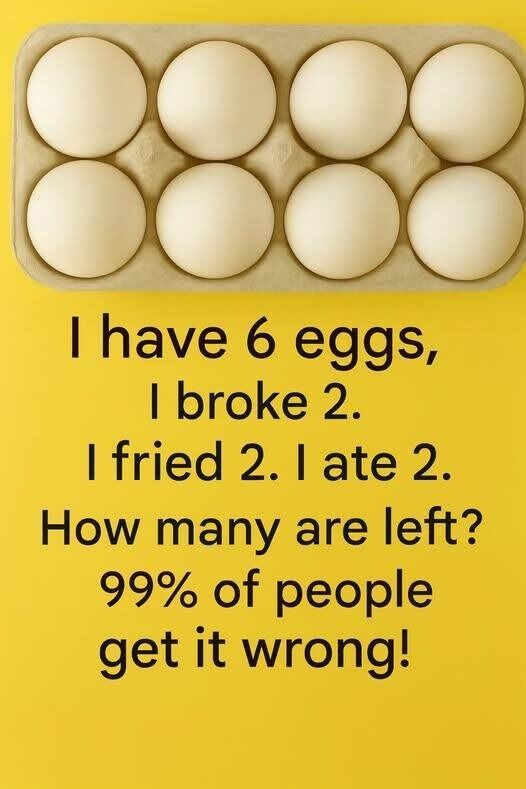
Brain teasers often look easy until they quietly challenge how quickly we jump to conclusions. One puzzle that continues to circulate online is the well-known “six eggs” riddle. At first glance, it seems like a basic counting question, but its real purpose is to test attention and interpretation rather than math skills. The challenge lies in slowing down and following the sequence of actions described.
The riddle typically presents a short scenario: someone starts with six eggs, then breaks two, fries two, and eats two. Many readers instinctively assume each action applies to a different set of eggs. That quick assumption leads to the conclusion that all six eggs are gone. This response feels natural because our brains often rush to add numbers instead of examining how the steps connect.
A closer look reveals the key detail. Eggs must be broken before they can be fried, and they must be fried before they can be eaten. That means the same two eggs move through each stage of the process. Only two eggs were ever used, not six. The remaining eggs were never touched, even though the wording makes it tempting to think otherwise.
The takeaway is simple but useful. Puzzles like this aren’t about tricking people—they’re about encouraging thoughtful reading and logical sequencing. By resisting the urge to answer quickly, you train your mind to look for clarity instead of assumptions. In this case, that small pause makes all the difference, revealing that four eggs are still safely left behind.