
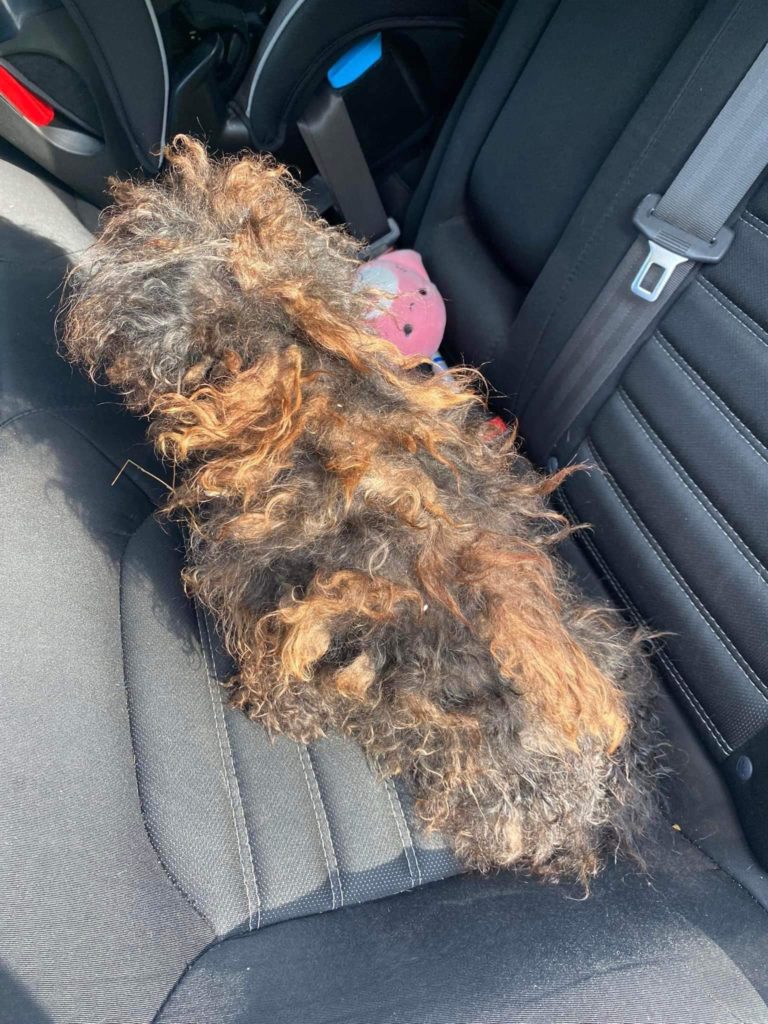
They didn’t choose her name until they discovered who she truly was. At first, she was barely recognizable as a dog at all—just a slow-moving shape along a Missouri roadside, mistaken by passing cars for debris. Years of neglect had wrapped her body in dense, hardened mats that pulled painfully at her skin with every step. When help finally arrived, she didn’t flee or fight. She simply stopped, as though movement itself had become something she no longer questioned.
At the rescue center, care unfolded quietly and deliberately. Clippers moved slowly through layers that no longer resembled fur, releasing dust and stale air that had been trapped for years. As the weight lifted, delicate skin emerged, unaccustomed to light or touch. She swayed under the sudden freedom, revealing injuries that told a silent story—an eye lost long ago, scars that marked experiences no one could fully piece together. Patience, not urgency, guided every step.
Her calm wasn’t trust; it was pure exhaustion, paired with a faint but determined instinct to keep going. Once the grooming ended, she appeared smaller and fragile, yet undeniably present. Wrapped in soft blankets, she ate carefully but with urgency, as if confirming that nourishment was finally hers. Then she slept—deeply and without fear—the kind of rest that only comes when safety feels real for the first time.
Her recovery didn’t arrive all at once or in a dramatic moment. It came quietly: a lifted head when someone entered the room, a pause that allowed gentle touch, a tail that moved just enough to signal hope. That’s when the name Pear fit—soft, simple, and bright. Her story reminds us that healing doesn’t rush. Sometimes, the most powerful transformation is choosing, again and again, to accept kindness and begin anew.