
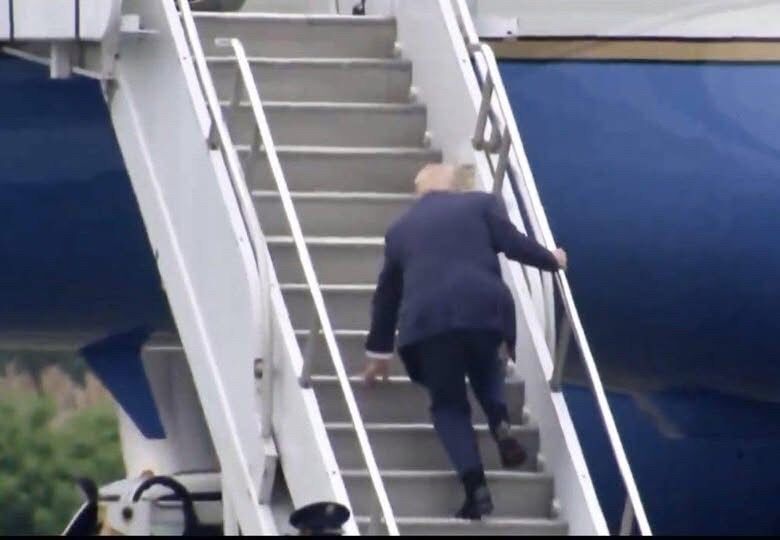
Public life now moves at a speed that would have felt unimaginable not long ago. With smartphones, instant video, and social platforms always within reach, ordinary moments can be recorded and shared in seconds. Once separated from their original setting, these brief clips often take on outsized meaning. For public figures, whose movements are constantly observed, even routine actions can quickly be transformed into symbols shaped more by interpretation than by reality.
That pattern was on display during a short incident involving Donald Trump while boarding Air Force One in June. The moment itself was fleeting and resolved immediately, drawing little notice from those nearby. In real time, it appeared minor and unremarkable. Online, however, short video clips circulated rapidly, turning a fraction of a second into a widely discussed topic.
Social media tends to amplify moments that are brief and visually noticeable, especially when they involve well-known individuals. When clips are shared without broader context, viewers often fill in the gaps with their own assumptions. Some saw an everyday human misstep, while others attached interpretations shaped by existing beliefs. In many cases, the reactions revealed more about perspective than about the incident itself.
Media coverage reflected that divide. Some outlets treated the moment as insignificant, while others focused on the online response it generated. Together, the reactions highlighted a larger reality of modern communication: visuals often travel faster than context. While the moment itself carried little meaning, it showed how quickly digital narratives can form—and spread—in an environment driven by speed, visibility, and reaction.