
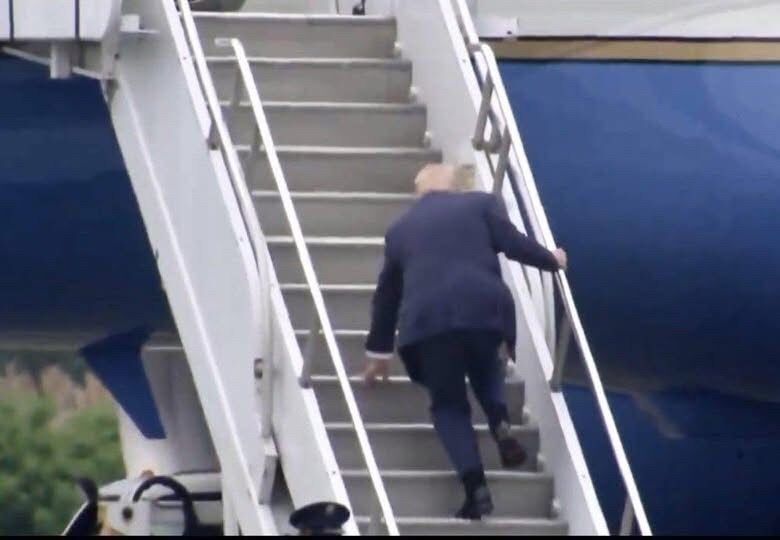
Public life now unfolds at a speed that would have been hard to imagine just a generation ago. With smartphones, high-definition video, and social platforms operating around the clock, nearly any public movement can be captured and shared within seconds. Ordinary actions are often removed from their original context and reframed into symbols. For political figures, whose presence is constantly scrutinized, even routine moments can quickly take on meanings shaped more by online interpretation than by reality.
That dynamic was on display when Donald Trump briefly stumbled while boarding Air Force One in June. The incident lasted a fraction of a second. He regained his footing immediately and continued without interruption. To those nearby, it appeared insignificant. Once short video clips began circulating online, however, the moment was replayed repeatedly and transformed into a talking point far beyond its original scale.
Social media platforms tend to amplify brief, visually striking moments—especially when they involve well-known figures. When a clip is isolated from its broader setting, viewers often project their own opinions onto what they see. Some interpreted the stumble as a routine human misstep, while others framed it as evidence supporting larger political narratives. The range of reactions said less about the moment itself and more about the polarized environment in which it was viewed.
Media coverage reflected that divide. Some outlets treated the incident as inconsequential, while others focused on the online response it generated, drawing comparisons to similar moments involving past leaders. In the end, the episode underscored a broader reality of modern public discourse: optics can overshadow substance. A fleeting physical moment revealed little about leadership, but it clearly illustrated how quickly narratives can form—and spread—in a digital age driven by speed, visibility, and reaction.