
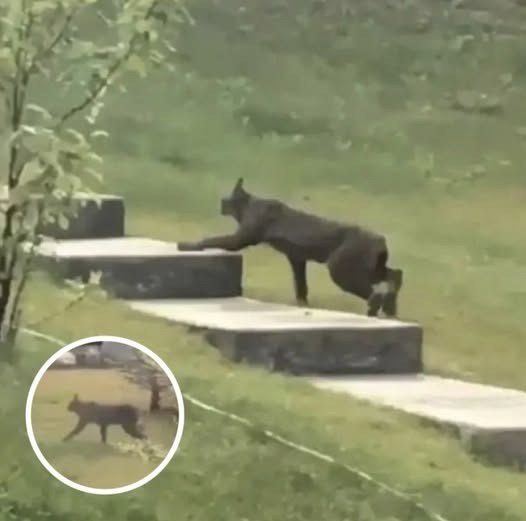
For generations, the Canada lynx has been a familiar symbol of northern wilderness—easily recognized by its tufted ears, oversized paws, and pale coat that blends seamlessly into snowy forests. That’s precisely why a recent discovery caught both scientists and wildlife enthusiasts off guard. For the first time, researchers documented what appears to be a melanistic Canada lynx—an individual with an unusually dark coat—captured on mobile phone footage as it moved quietly through its habitat like a shadow against the snow.
Under normal conditions, the species’ light gray or reddish-brown fur plays a critical role in camouflage, helping it stalk prey in winter landscapes. The newly observed lynx, however, displayed melanism, a rare condition that increases dark pigmentation. While melanism is known in other animals—particularly big cats in warmer climates—it has not been previously confirmed in this species. The sighting raises intriguing questions about whether hidden genetic variation has gone unnoticed in remote regions for years.
What makes the case even more compelling is the apparent contradiction it presents. A darker coat in a snow-covered environment would seem like a disadvantage, potentially making hunting more difficult and increasing visibility. Yet the lynx appeared healthy and alert, suggesting it had adapted effectively to its surroundings. Researchers are now considering whether behavioral changes, environmental shifts, or broader ecological factors could influence how such traits persist, though they emphasize that one sighting is not enough to draw firm conclusions.
Beyond the scientific curiosity, the footage has resonated widely because it reminds us how much of the natural world remains unknown. Even well-studied species can still surprise us, revealing layers of complexity that challenge our assumptions. This rare lynx has become more than a biological anomaly—it’s a quiet symbol of biodiversity’s depth and the importance of protecting ecosystems where such unexpected wonders can still exist.