
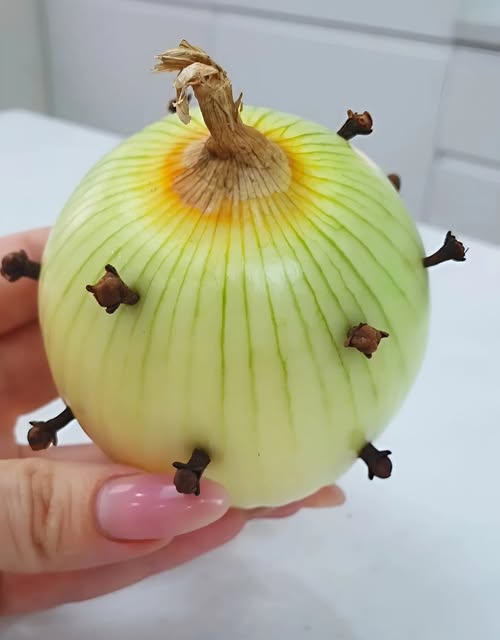
When I was little, my grandmother’s kitchen was the heart of our home — filled with sunlight, simmering pots, and the scent of comfort. Yet one habit of hers always fascinated me. Before any soup, stew, or sauce began to bubble, she’d take a whole onion, press a few cloves into its skin, and gently lower it into the pot. I used to laugh at the sight of that odd, spiky onion floating among the vegetables. She’d simply smile and say, “You’ll understand when you’re older.” Years later, standing over my own stove, I finally did.
That simple ritual wasn’t just an old-world superstition; it was a classic culinary technique known in French cooking as oignon piqué. By securing cloves — and sometimes a bay leaf — into the onion, my grandmother was adding layers of flavor in the most effortless way. As the onion softened, its sweetness mingled with the warm spice of the cloves, transforming ordinary meals into something fragrant, balanced, and deeply comforting.
There’s even a bit of chemistry behind her secret. Cloves contain eugenol, the natural compound that gives them their signature aroma and subtle medicinal qualities. When heated in broth or sauce, eugenol releases slowly, infusing flavor without overwhelming the dish. Anchoring the cloves in the onion keeps everything tidy — the flavor stays, but the whole piece can be lifted out easily once the cooking is done.
Now, whenever I cook, I still follow her method. Whether I’m preparing a cozy soup or a creamy béchamel, the scent of that clove-studded onion fills my kitchen with memory. It’s more than a recipe — it’s a reminder that love often hides in the smallest traditions, carried quietly from one generation to the next.