
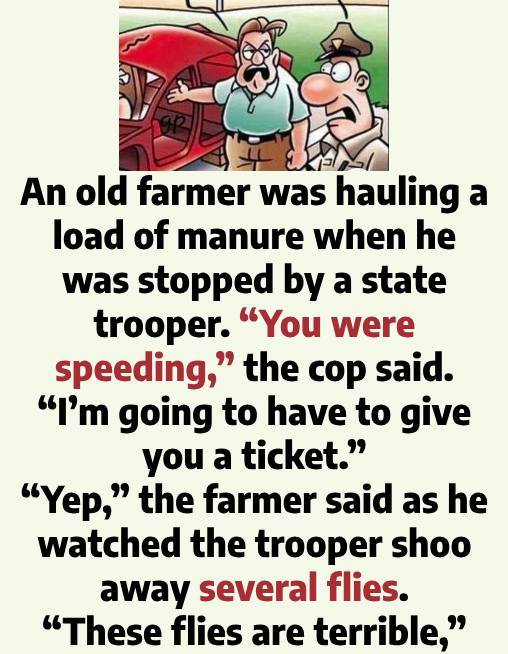
An elderly farmer was driving slowly down the road with a trailer full of manure when flashing lights appeared behind him. A state trooper pulled him over and explained he’d been speeding. As the officer spoke, he kept swatting at several flies buzzing stubbornly around his head. “These flies are awful,” the trooper muttered. The farmer nodded calmly and said, “Yep. Those are circle flies.” Curious, the trooper asked what that meant. “Flies that circle around a horse’s backside,” the farmer replied. The officer paused, narrowed his eyes, and asked if the farmer was calling him a horse. “Nope,” the farmer said. “But those flies seem convinced.”
In a classroom miles away, a student named Jacob decided to test his teacher’s patience with a series of questions. He raised his hand and asked, “How do you put an elephant in the refrigerator?” The teacher shrugged, unsure. “Easy,” Jacob said. “You open the door and put it in.” Feeling clever now, the teacher smiled when Jacob followed up: “How do you put a giraffe in the refrigerator?” Confidently, she answered, “Open the door and put it in.” Jacob shook his head. “No—you open the door, take the elephant out, and then put the giraffe in.”
Jacob wasn’t finished. “All the animals went to the lion’s birthday party,” he said. “One didn’t show up. Which one?” The teacher guessed the lion. “Nope,” Jacob replied. “The giraffe—he’s still stuck in the fridge.” By now, the class was fully engaged, and the teacher was cautiously bracing for what came next.
Jacob delivered his final question: “There’s a river filled with alligators, and you need to cross it. How do you do it?” The teacher thought carefully and answered, “You find a bridge.” Jacob grinned. “No—you swim across. All the alligators are still at the party.” Sometimes, the best jokes don’t rely on complicated setups—just a little logic, a bit of misdirection, and the perfect timing to make you smile.