
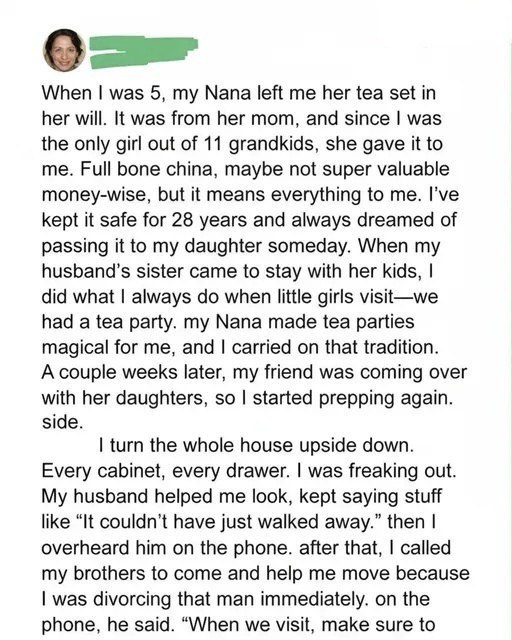
When I was five, my grandmother handed me a porcelain tea set that had once been hers — a fragile treasure wrapped in generations of love. I wasn’t the eldest grandchild or the most responsible, but she said she trusted me to keep it safe. Though its value wasn’t measured in money, it became priceless to me — a symbol of connection, care, and the quiet strength of women in my family. For nearly thirty years, I kept that set protected, promising myself I would one day share it with my own daughter, just as my grandmother had shared it with me.
Whenever children visited, I always used a sturdy, everyday set, keeping the heirloom tucked away. But one sunny weekend, my husband’s sister arrived with her two kids, and nostalgia got the better of me. I brought out the real tea set for a special playtime. The laughter and joy that filled the room made it worth the risk — until a few weeks later, when I went to prepare for another visit and discovered the set was gone. Panic turned to disbelief as I searched every corner of the house, unable to shake the feeling that something precious had quietly slipped away.
Then, while clearing the kitchen one evening, I overheard my sister-in-law telling someone she had given her daughter the set, thinking she was honoring me by “letting it be used again.” My heart sank — not from anger, but from the realization of how easily love can be misunderstood when meaning isn’t shared. What she saw as a kind gesture had unintentionally crossed a boundary rooted in memory and trust. It was a painful but necessary reminder that communication is as delicate as porcelain — one careless moment can crack what took generations to build.
When we finally spoke, she listened, apologized, and returned the tea set. I placed it back in its familiar place, feeling both humbled and grateful. That experience reshaped how I think about inheritance and connection. The tea set now reminds me not only of my grandmother’s faith, but also of the importance of open conversations, empathy, and respect within families. In the end, heirlooms don’t just preserve history — they remind us to handle one another’s hearts with care.