
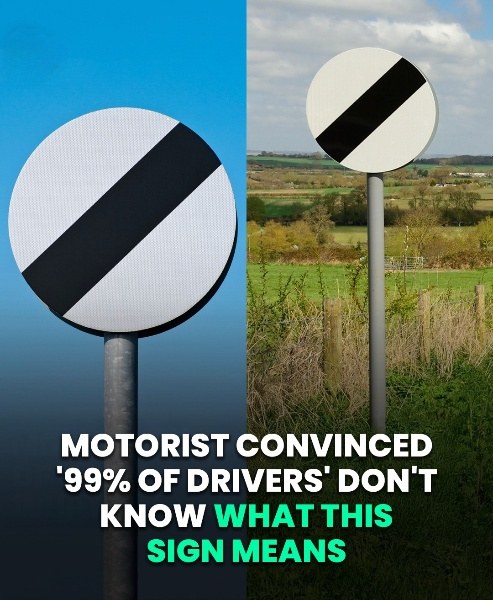
A motorist in the UK recently reignited an online debate after claiming that most drivers fail to recognize the meaning of a familiar road sign. The circular white sign with a bold black diagonal stripe is commonly misunderstood, even though it appears in the official theory test. Many drivers either forget its purpose or misinterpret it once they are on the road, leading to widespread confusion.
The sign in question indicates the national speed limit, which varies depending on the type of road and vehicle. For cars, the maximum is 60 mph on single carriageways and 70 mph on dual carriageways or motorways. Larger vehicles, such as vans or those towing trailers, must observe lower limits — 50 mph on single carriageways and 60 mph on dual carriageways or motorways.
In urban areas with street lighting, the standard speed limit remains 30 mph unless signs state otherwise. Despite these rules, online discussions often mock the sign, with drivers jokingly interpreting it as “no speed limit” or “drive as fast as you want.” In reality, many motorists push beyond the limits or fail to adjust their speed, creating unsafe conditions on the roads.
Road safety organizations stress that the sign sets only the maximum legal speed and that drivers must always adapt to conditions such as traffic, weather, or visibility. Groups like the RAC remind motorists that safe driving depends on judgment as much as legal limits. The misunderstanding around this common sign highlights the need for continuous driver education and a reminder that passing a test does not guarantee lasting road knowledge.