
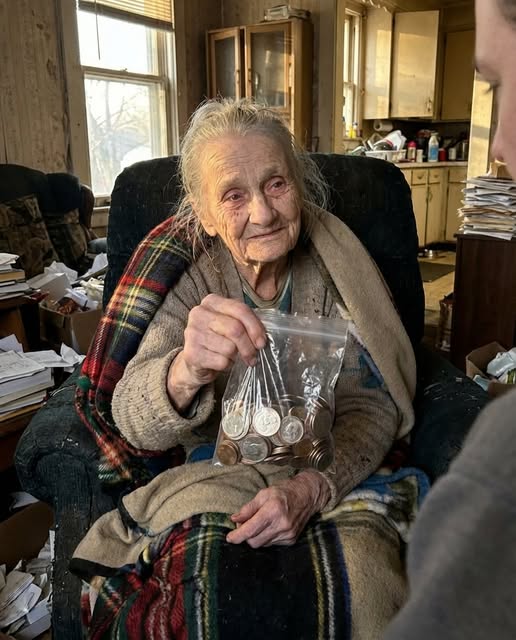
The cold reached me before I even got to the door, but something about that delivery had already unsettled me. The house was dark, the yard looked neglected, and the only instruction on the order was simple: “Knock loud.” Inside, I found an elderly woman wrapped in layers of blankets, sitting in a bitterly cold room lit by a single candle. She held out a plastic bag of coins to pay for her pizza, and in that instant, it became clear this was not just dinner—it may have been the only real warmth she would have that day.
I could not bring myself to accept her money. I told her the meal had already been paid for, then walked back to my car with a feeling I could not shake. The image of that freezing house and the nearly bare refrigerator stayed with me long after I left. I knew I would regret it if I simply drove away and treated the moment like any other stop on my route. So I made a call for a welfare check, believing it was the most responsible way to make sure someone looked in on her and offered help where it was clearly needed.
Later, when I passed by and saw an ambulance parked outside, doubt hit me harder than the cold ever had. As paramedics helped her from the house, she looked directly at me and said, “This is your fault.” Those words stayed with me for days. Neighbors questioned what I had done, and I started questioning it too. I wondered whether I had stepped in with compassion or overstepped in a way that took away her dignity. What I thought was an act of care suddenly felt tangled with guilt, uncertainty, and the fear that I had made a difficult situation worse.
A week later, I returned to that same address and found a scene I never expected. The house was warm, stocked with groceries, and filled with movement, conversation, and support. Neighbors had stepped in, organized help, and begun checking on her regularly. She looked healthier, steadier, and more at ease. This time, when she saw me, she thanked me. In the end, what first felt like a painful mistake became the beginning of something better. Sometimes the right choice does not bring instant relief—but it can open the door to care, community, and change in ways no one sees at first.