
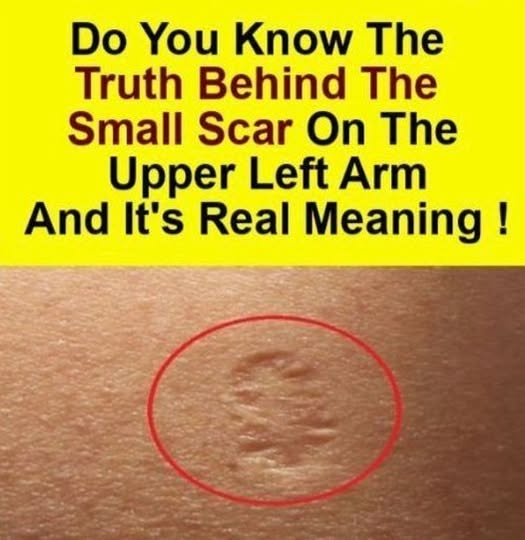
As a child, I was quietly fascinated by a scar on my mother’s upper arm. It sat just below her shoulder, visible only when she wore short sleeves, as if it revealed itself selectively. The mark was unlike any other I’d seen: a small circle of faint impressions surrounding a deeper center. Even then, I sensed it wasn’t the result of a fall or an accident. It looked deliberate, purposeful—like a story etched into skin. I didn’t know why it held my attention so strongly, only that it did.
Over time, that curiosity faded the way childhood questions often do. The scar never changed, but my awareness of it did. If I ever asked my mother about it—and she later insisted I had—the answer didn’t stick. What remained was the image itself, not its meaning. Years passed, and the mark slipped fully into the background of memory, unnoticed and unexplored.
Then one summer afternoon, everything shifted. While helping an elderly woman step off a train, her sleeve moved slightly, and there it was again—the exact same scar. Same circular shape. Same faded texture. Same placement. The sight stopped me cold. In an instant, my childhood curiosity returned, now sharpened by recognition. This wasn’t coincidence. It was something shared, something generational. As soon as I could, I called my mother. She laughed gently and reminded me of what I’d forgotten: the scar came from the smallpox vaccine.
That simple explanation opened the door to a much larger history. For centuries, smallpox was among the deadliest diseases humanity faced, killing millions and leaving survivors scarred or blind. During the 20th century alone, it claimed countless lives before science intervened. The vaccine—administered using a distinctive multi-puncture method—left behind that familiar circular scar as proof of immunity. Routine for children born before the early 1970s, it became part of everyday life until smallpox was officially declared eradicated by the World Health Organization in 1980. Today, that small mark feels profound. It’s a quiet reminder that history isn’t only written in books or headlines—sometimes it lives on the body, bearing witness to resilience, cooperation, and one of humanity’s greatest public health triumphs.