
I wanted to believe it was nothing. I told myself it was just some dusty old boxes or tools. But Rocky wasn’t the kind of dog to get obsessed over nothing. He was gentle, sweet, but sharp in ways that surprised me. He always knew when I was upset before I said a word. He could sense when Mike was about to get home, sometimes minutes before the car pulled into the driveway. And he knew, without fail, whenever someone walked past the house, even in the middle of the night.
So why this fixation on a locked door?
The night everything changed started out unremarkable. It was late October, one of those crisp evenings where the air smells faintly of woodsmoke. We’d gone out to a friend’s birthday dinner and come back full and a little sleepy.
Mike had a call from a client he couldn’t miss, so he stepped out to his workshop behind the house. I stayed inside with Rocky.
I curled up on the couch with a blanket, but Rocky was restless, pacing back and forth. Finally, he padded down the hall, glancing back at me as if to say, Come on.
I followed.
He stopped in front of the locked door, sat, and looked straight at me.
“What do you want me to do, buddy?” I whispered.
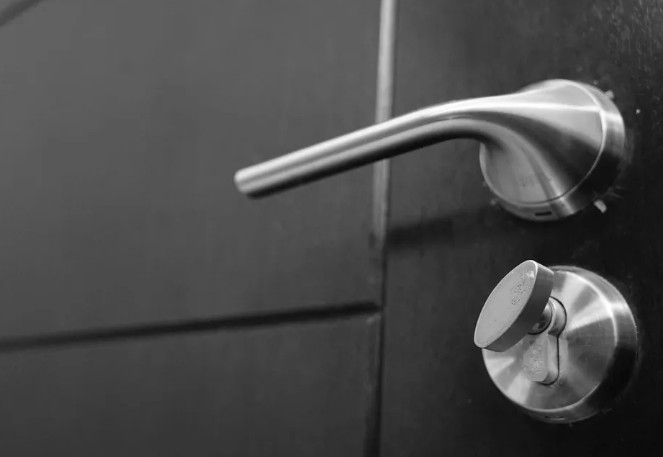
And then — I swear — the brass handle twitched.
Just a tiny movement, like the door had shifted under pressure. My breath caught. Rocky gave a low whine.
I crouched, pressing my ear against the cool wood. Nothing. Silence. But the handle had moved, I was sure of it.
I straightened up, heart pounding. Maybe it was my imagination. Maybe old houses shifted, wood expanded and contracted, handles creaked. I tried to reason with myself.
But Rocky’s stare was unrelenting.
That was when I remembered something: Mike kept a set of keys on a hook in the kitchen, a whole jangling collection. I’d never asked about them.
I glanced toward the back door, where Mike’s workshop light glowed faintly. He’d be out there a while.
Before I could overthink it, I hurried to the kitchen, grabbed the keys, and returned to the hallway. My hands shook as I tried the first one. No luck. The second didn’t fit either. On the third try, the lock clicked.
Rocky’s ears shot up.
I hesitated only a moment before pushing the door open.
Inside, I found… not what I expected.
Not at all.
The room wasn’t dark and cobwebbed, and it wasn’t crammed with boxes either. It was tidy, almost reverent, like a small museum carefully curated.
The first thing I saw was a row of wooden chairs lined against the far wall. Not ordinary chairs — each was handcrafted, each unique. One had intricate carvings of oak leaves along the arms. Another was curved in a way that made it look almost like it was leaning forward to listen. They were beautiful, in a quiet, haunting way.
Against another wall stood shelves filled with photo albums, neatly labeled in Mike’s handwriting. And on a wide worktable in the center of the room sat a half-finished piece — a chair, delicate and unusual, with a tall back shaped almost like wings.
Rocky padded in beside me, tail low, sniffing the air. He wasn’t anxious anymore. He seemed calmer, like he’d been waiting for me to see this.
I walked slowly around the room, fingertips grazing the polished wood of the chairs. Each one felt alive somehow, full of story.
Finally, I reached the shelves. Curiosity tugged at me, and I pulled one of the albums free.
Inside were photographs — black-and-white, yellowed with age. Families posing together. Children sitting stiffly, parents standing behind them. All of them were seated in chairs. Chairs that looked exactly like the ones in the room.
I flipped page after page, heart thudding. Different families, different decades, always the same chairs.
Somehow, impossibly, they were here in front of me.
“What is this?” I whispered to Rocky, who looked up at me with steady brown eyes.
That was the moment I heard footsteps in the hall.
I spun around as Mike appeared in the doorway. His face froze when he saw the key in my hand, the open album in front of me.
“I can explain,” he said quickly, voice tight.
I stepped back, clutching the album. “Explain what? Why do you have… why do you have all these?”
Mike came inside, running a hand through his hair. “I knew you’d wonder. I just… I didn’t know how to tell you.”
“Tell me what?”
He glanced at Rocky, then back at me. “These chairs. My father made them. And his father before him. It’s a tradition in my family. We build a chair for each generation. For each family that comes to us.”
I frowned, not understanding. “Comes to you for what?”
“For memory,” he said quietly. “For keeping something alive.”
He walked to the unfinished chair on the worktable, resting a hand on its smooth back. “When someone loses a loved one, they come here. We built a chair. Something sturdy, lasting. The family sits in it together for a photograph. And then… we keep the chair. We keep the memory. It’s how we honor them.”
I stared at him, at the rows of chairs, at the albums. “So these are… memorials?”
He nodded. “Yes. That’s what’s behind the locked door. Not junk, not secrets. Just the past. People trust me with it.”
I sank onto one of the chairs, my knees weak. It was overwhelming — eerie, yes, but not in the way I’d feared. It wasn’t about hiding something dark. It was about preserving something fragile.
“Why didn’t you just tell me?” I asked finally.
Mike’s shoulders slumped. “Because most people don’t understand. They think it’s morbid or creepy. And I didn’t want you to see me that way. I didn’t want you to walk away.”
I looked down at the photo album still in my hands. The faces staring up at me weren’t frightening. They were ordinary, tender. Families clutching each other a little too tightly, children trying to smile through tears. It wasn’t death I saw in those pictures. It was love refusing to disappear.
Rocky leaned against my leg, warm and steady. He’d known, somehow, that I needed to see this. That it wasn’t something to be afraid of.
I closed the album carefully and set it back on the shelf.
“I’m not walking away,” I said.
From that night on, the locked room wasn’t locked anymore. At least, not to me.
Sometimes, after dinner, Mike would take me inside and tell me the stories he knew about certain chairs — the widow who’d brought her husband’s work boots and asked if the grain of the wood could match them, the little boy who wanted his father’s initials carved into the armrest. Mike didn’t know every detail, but he remembered enough. And as he spoke, I realized he wasn’t just a carpenter. He was a keeper of stories, a bridge between what was lost and what remained.
I helped him once, sanding the edge of a chair meant for a family I’d never met. My hands grew sore, dust clung to my skin, but when the smooth curve of the wood caught the light, something inside me softened. It felt like shaping more than furniture. It felt like shaping memory itself.
Rocky always lay at our feet as we worked, content, as though finally satisfied that the truth was no longer hidden.
And me? I no longer wondered about the locked door. Because I’d learned that sometimes secrets aren’t about hiding something shameful. Sometimes they’re about guarding something sacred, waiting for the right person to understand.
Everyone hides something. Mike’s secret wasn’t darkness. It was light — carved, sanded, and polished until it gleamed.
And thanks to a golden retriever who wouldn’t stop asking me to look closer, I got to be part of it.